Qualities That Do Not Make It to Your CV (I): The Problem & Solution
In a world flooded with AI-generated resumes, the advantage is no longer having a “perfect-looking” CV — it’s having one that is authentic, credible, and deeply aligned with who you are and where you want to go. This article explores the growing trust gap in AI-assisted career tools, why generic optimization can backfire, and how professionals can use AI thoughtfully without losing their voice, context, or individuality.
There is a category of objects that were useful once, became conventional, and then quietly turned into a liability. Paper receipts. Neckties. Women’s clothing without pockets.
The CV belongs on that list.
Not because it was a bad idea — it solved a real problem. At some point in history, a hiring manager needed a way to process more applicants than they could meet. A standardized document made sense. It was operationally convenient, and convenience has a way of becoming tradition.
The problem is that tradition does not come with an expiry date.
What a CV Actually Measures
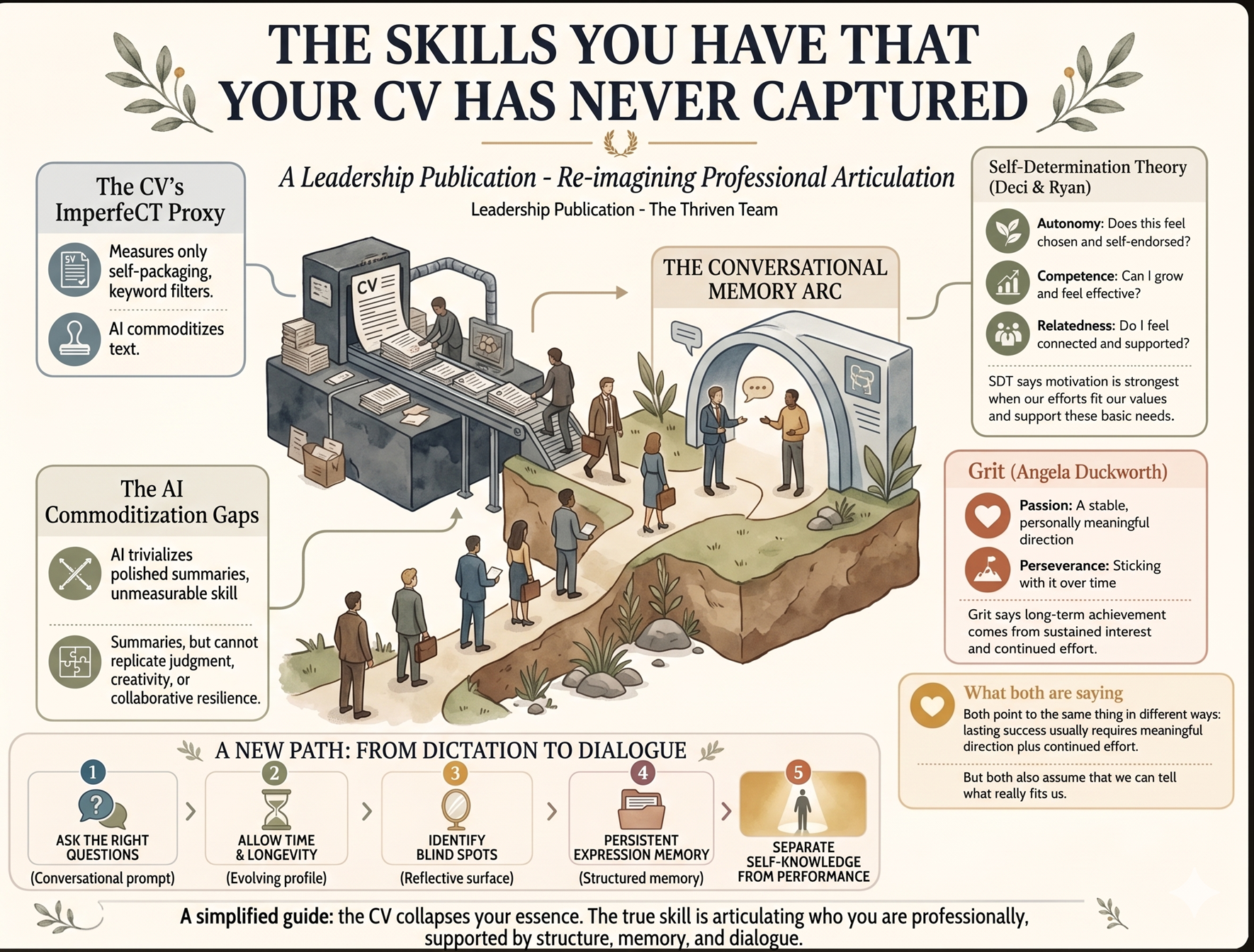
If you strip away the formatting and the action verbs, a CV is primarily a test of one skill: self-packaging. The candidate who lands the interview is not necessarily the most capable person in the applicant pool.
They are the person best at compressing their career into a scannable narrative that matches a keyword filter written by someone who has not done the job in five years.
What gets left out is almost everything that makes someone genuinely good at their work.
Not capability — the judgment call made under pressure with incomplete information.
Not adaptability — the time someone quietly rebuilt a broken process without being asked or credited.
Not collaboration — the kind that doesn’t show up in a deliverable but holds a team together.
Not creativity.
Not communication.
Not the way someone handles failure, which is arguably the most predictive variable of all.
The CV does not have a field for any of this. And the things that cannot be measured by a document tend to get dismissed as unmeasurable, which is a very different problem than being unimportant.
There is a further irony that AI has introduced. The parts of the CV that were always weakest — the polished summary, the tidied bullet points, the elevated language — are now trivially easy to generate. Which means the document that was already an imperfect proxy for ability has now become even less reliable as a signal of anything. The formatting
got commoditized. The honesty did not improve.
The Interview Scene We Are Heading Toward
Imagine how a technical interview might go in the next couple of years.
The candidate walks in, prepared. They have a degree, scaled distributed systems to handle millions of requests, designed sophisticated architectures to solve genuinely hard problems.
Recruiter: “So, tell us about yourself.”
Candidate: “Well, I have a degree in X, I’ve scaled distributed systems to handle millions of — “
Recruiter: “Let me stop you there. We’ve already verified your technical logic with our AI auditor. You’re clearly capable. But — tell us about yourself.”
Candidate: [pause]
Recruiter: “What actually excites you? What brings you down? Are you an empathetic leader or a cold-fact problem solver? Give us the human stuff.”
Candidate stares. Blinks twice. “I… I thought you’d never ask.”
This is not a dystopian scenario. It is the natural conclusion of a trajectory already in motion. The technical floor keeps rising, AI handles more of the heavy lifting, and what differentiates people at the margin becomes entirely the things a CV was never designed to capture: deep judgment, genuine communication, the ability to lead without ego or follow without resentment, the capacity to be honest about uncertainty.
We spent a decade optimizing for machine-readability. The résumé became a document written for algorithms. The interview became a performance rehearsed for expected questions. We learned to speak in bullet points and quantified impact and percentage improvements.
The Gap That Exists Now
Most people have more professional substance than they can articulate on demand. Not because it isn’t there — it is — but because they have never been asked the right questions in the right order, over enough time, by something that remembers the answers.
If you were to design a better system from scratch, it would not look like a document. It would be conversational — because self-knowledge surfaces through dialogue, not dictation. It would be longitudinal — because who you are professionally is not a snapshot, it is a pattern that only becomes visible over time. It would be honest about your blind spots in a way you cannot be on your own, because you cannot see the shape of something you are standing inside. And it would separate the act of knowing yourself from the act of performing yourself for an audience.
A CV collapses all of that into two pages. It asks you to know yourself and perform yourself simultaneously, and then treats the result as a reliable signal.
The interesting thing is that the technology to do this differently has existed for a while. Conversation at scale is not hard anymore. Persistent memory is not hard. Pattern recognition across what someone says and does over weeks and months — not hard. The question was never whether it was technically possible. It was whether anyone would build it in the right way and tackle the pain points that we all feel.
Which is why the most useful version of this thing ends up looking less like a tool and more like a conversation that has been paying attention.
So we end up with rich continuous data that builds up over time. Such a system will also allow us to build a habit of documenting our journey, be more expressive, and realize our weaknesses before our strengths.
The Skill Nobody Put on Their CV
We have spent a long time learning to represent ourselves in the language that systems could process. Now the systems can generate that language on their own, and the question has shifted.
The most valuable professional skill right now might not be a technical one at all. It might be the ability to articulate who you are, why you make the decisions you make, and what you care about enough to do well even when nobody is looking.
That is not a soft skill. That is the skill. And no CV ever asked for it.
We have spent a decade learning to speak like machines. Now, the most valuable thing will be learning how to be human again.