Qualities That Do Not Make It to Your CV (II): Use Cases From History
A CV records where someone has been, but misses how they think under uncertainty. History's greatest breakthroughs—from penicillin to early epidemiology—didn't come from flawless credentials, but from the unmeasurable capacity to notice anomalies and pursue inconvenient truths. We’ve spent a decade learning to speak like machines; now, the ultimate skill is learning how to be human again.
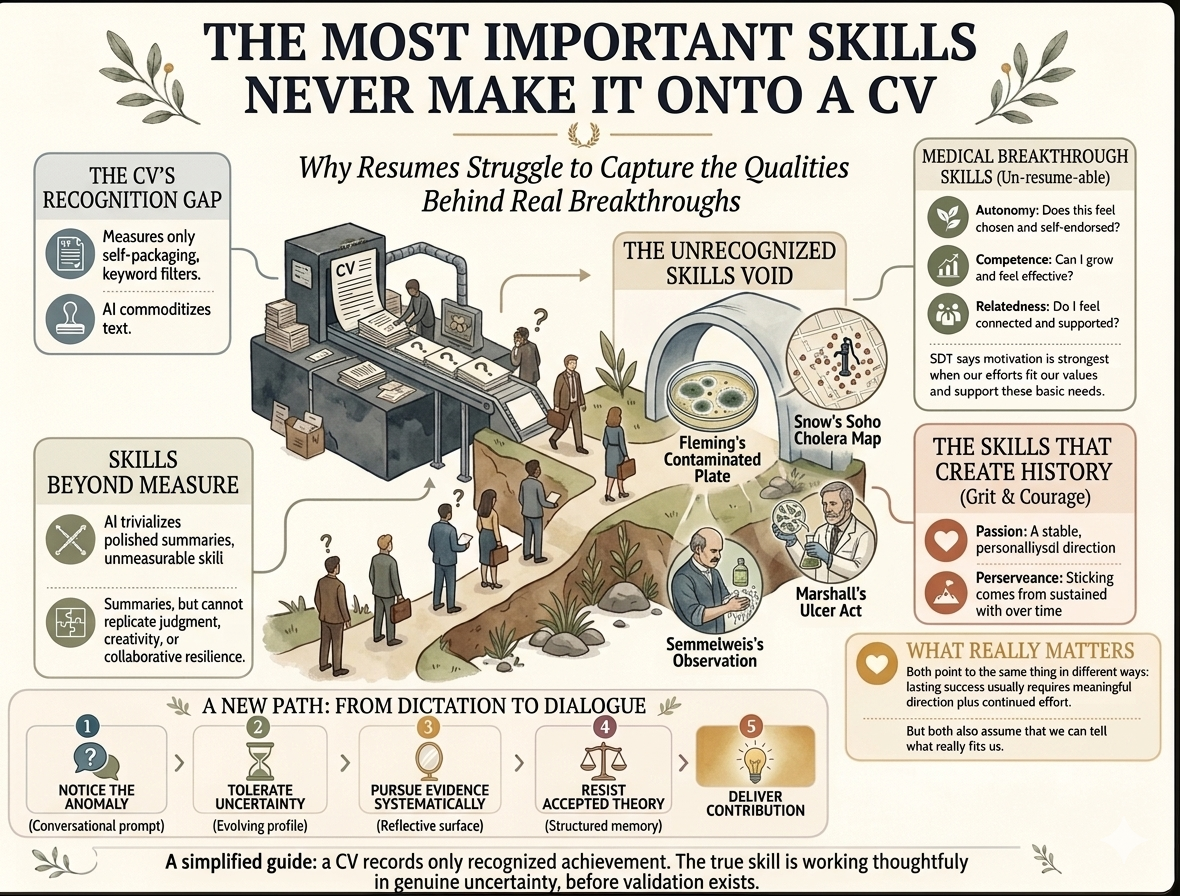
Medical science is full of discoveries that did not come from the qualities we usually know how to reward on a resume. A CV can show degrees, titles, publications, grants, and institutional affiliations. But it rarely shows the stranger, deeper skills behind many breakthroughs: noticing what others are quick to dismiss, asking the question, tolerating ridicule and uncertainty, finding ways to test a hypothesis or hunch, changing one’s mind, resisting pressure, and staying with a problem long after the obvious answers have failed.
Alexander Fleming and the “Mistake” That Changed Medicine
Take Alexander Fleming. In 1928, he returned from holiday to find that one of his bacterial culture plates had been contaminated by mold. Most people would have thrown it away as a failed experiment. Fleming looked closer. Around the mold, the bacteria had died. The discovery of penicillin began not with flawless execution, but with the ability to stop and notice what most people would consider to be a ‘mistake’ and think beyond. What skill is that on a resume? “Attention to detail” is not it. Sounds small, almost silly. “Curiosity” sounds banal. “Questioning” is not right either. No, the real skill was two-fold: the inclination to ask why something happened instead of dismissing it as a mistake (which is rare enough) and following it up (which is rarer still).
John Snow and the Courage to Question “Settled Science”
Consider John Snow. In 1854, a cholera outbreak swept through the Soho district of London, killing hundreds of people in days. The accepted medical theory of the time was miasma — the belief that diseases spread through bad air (the smell of the streets, the fog, the general filth of a Victorian city). This was considered settled science. This was the dominant belief at the time. Snow approached it differently. He walked the streets of Soho with a notebook and mapped every death, house by house, case by case. The pattern that emerged pointed not to bad air but to a single water pump on Broad Street. He persuaded the local authorities to remove the pump handle. The outbreak stopped. Just imagine. It seems commonplace now, but at that time it was anything but.
Snow had no germ theory to explain his finding. He could not have known by any means why a pump of all things was spreading a disease. The mechanism was unknown to him. It must have made no sense at all. Yet what he had was a method — careful, systematic observation — and the willingness to let the data lead him somewhere the theory did not explain. His map is now considered one of the founding documents of modern epidemiology. It hangs in public health schools around the world. At the time, much of the establishment continued to believe in the miasma theory for years afterward.
What Snow had done and how he had done it would never fit in a resume. It was the patience to build evidence carefully, the ability to reach a conclusion completely counter to the prevailing theory, and the guts and clarity to act on it. What he had was pattern recognition and the courage to define the problem differently. What would this skill be on a resume? “Common sense?” “Right Attitude”? “Mapping Skills”? None of these fit into a bullet point, yet his way of geographically mapping evidence helped create the foundations of modern epidemiology.
Ignaz Semmelweis and the Cost of Seeing the Truth Early
Then there is Ignaz Semmelweis, who noticed that women were dying of childbed fever far more often in one maternity ward than another. He traced the difference to doctors moving from autopsies to childbirth without washing their hands. His solution — handwashing with chlorinated lime — dramatically reduced deaths. But his insight was rejected by much of the medical establishment. Semmelweis saw what others did not want to see: that the healers themselves might be transmitting disease. That required not only observation, but moral courage. A resume might say “improved clinical outcomes.” It would not capture the cost of seeing an uncomfortable truth before others were ready to accept it.
Barry Marshall and Challenging the Accepted Story
Barry Marshall faced a different kind of resistance. For decades, stomach ulcers were believed to be caused mainly by stress and acid. Marshall and Robin Warren suspected that a bacterium, H. pylori, was involved. The idea was dismissed. To prove the point, Marshall drank a culture of the bacteria, developed gastritis, and treated himself with antibiotics. The story is extreme, but the underlying quality is familiar: the willingness to challenge a settled explanation when the evidence points elsewhere. Again, what would the CV say? “Questioned prevailing assumptions”? “Demonstrated initiative”? The language becomes trivial compared with the act.
The Pattern Behind Breakthroughs
The same pattern appears again and again. Medical progress often depends on people who can see the anomaly, ask the better question, and persist through disbelief. These are not always the people with the most polished credentials. They are the people who notice the contaminated plate, the death map, the unexplained mortality pattern, the contradiction in the standard theory. What these people had was not mere intelligence or discipline - though they had both in extraordinary measure - but the ability to pursue questions that had no established framework around them. That quality — the willingness to work in genuine uncertainty, to pursue something before its value is recognized, to persist without institutional support and validation — does not appear on CVs. A CV records what has already been recognized. This quality operates in the space before recognition exists.
This Problem Exists Far Beyond Medical Science
The same is true outside medical science. In everyday work, the most valuable person in a room is often not the one with the longest list of credentials. It may be the person who senses that the team is solving the wrong problem. The person who asks the most fundamental questions, who notices that the data looks too clean. The person who can explain a technical issue so clearly that a nontechnical leader finally understands the risk. The person who earns enough trust that others tell them what is really happening.
These skills rarely appear in a CV because they are hard to name. They do not come with certificates. They are often visible only in retrospect, after the crisis has passed or the discovery has been made. But they may be the very skills that separate routine competence from genuine contribution.
What Resumes Cannot Capture
Resumes tell us where someone has been. They tell us what titles they held and what outputs they produced. But it cannot tell us how they think under uncertainty, what they notice when others stop looking, whether they can resist a currently popular but wrong answer, or whether they have the courage to pursue an inconvenient truth with a systematic thought process. Resumes are bad at capturing the capacities that make achievement possible: judgment, evidence building, skepticism, intellectual courage, intellectual honesty, ethical discomfort, patience, observation, testing, and the ability to change direction when reality refuses to match the story.
These things do not appear on any resume. They rarely come up in any interview.
And yet, in most careers, they end up mattering more than almost anything else on the page. What are some of your qualities that will never be captured in a CV? We would love to know them.